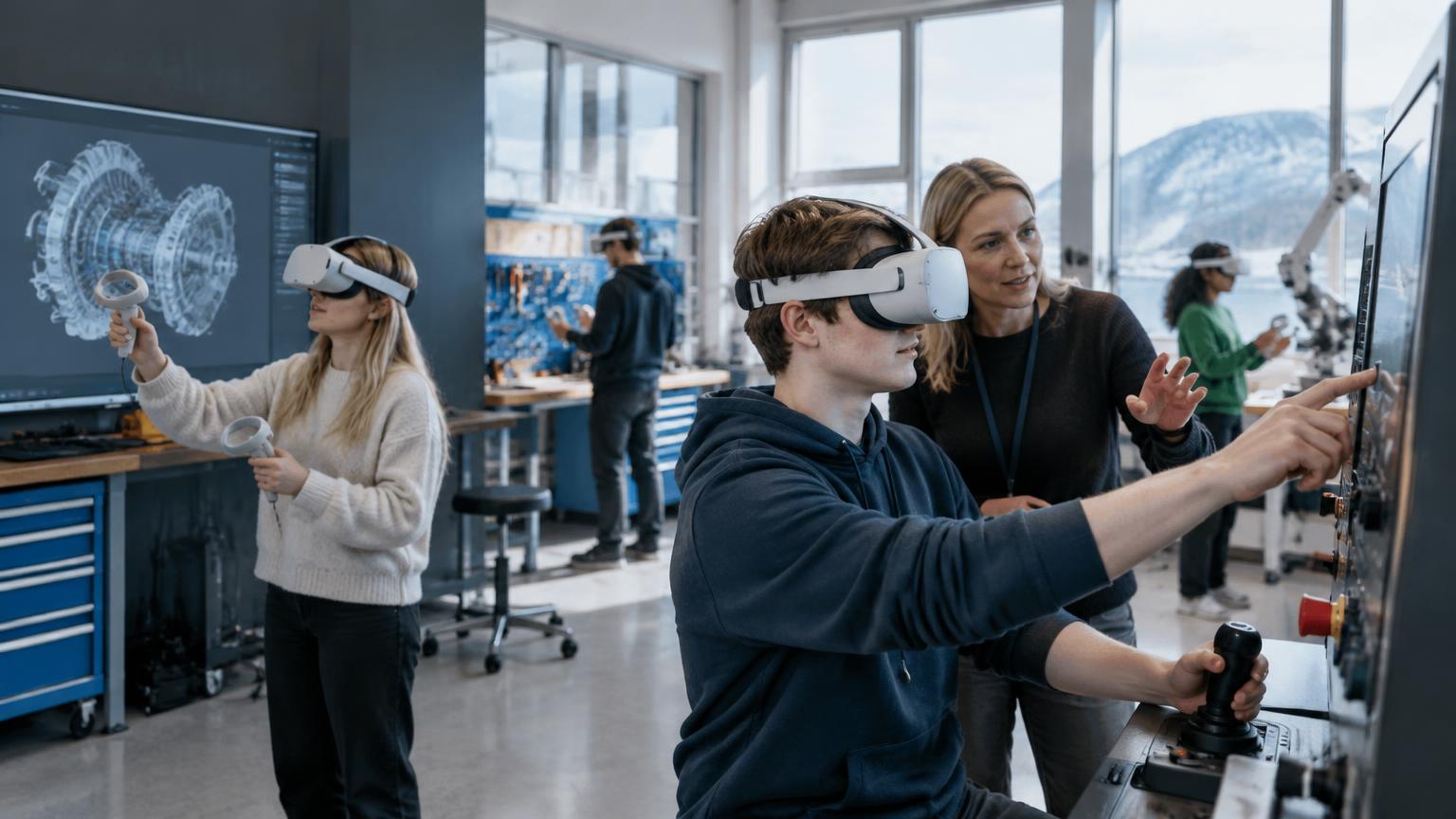
Students and a teacher using virtual reality in a modern vocational learning environment

    XRPK Education · Immersive learning

    Turn difficult lessons into experiences students can practise

    We help schools, vocational institutions and technical colleges make learning more engaging, practical and accessible through curriculum-aligned immersive experiences — delivered from Denmark across the Nordics, Europe and worldwide.

    Who it's for

    Built for schools and vocational education

    Schools (K-12)

    Curriculum-aligned immersive experiences for primary and secondary education — science, geography, history, safety and citizenship.

    See school applications →

    VET & technical colleges — our focus

    Repeatable, safe practice for machinery, skilled trades, logistics and laboratory work before learners meet live equipment.

    See VET applications →

    Universities & professionals

    Higher education and professional development are served by XRPK Academy — certified transformation training and live workshops.

    See higher-education options →

    Flagship annual partnership

    The Immersive Learning & Innovation Programme

    A complete annual partnership for schools and VET colleges: VR, interactive 3D, simulations, digital twins and emerging AI — combined with curriculum design, teacher development and student innovation. From curriculum to experience, from 100,000 DKK/year.

    • Curriculum-mapped immersive experiences, not a content library
    • Teacher Academy: facilitation, devices and lesson integration
    • Student innovation projects and measurable learning evidence
    • Starts with a structured, low-risk pilot

    How we could help

    Two practical starting points for a Danish education pilot

    These are proposed pilot scenarios, not claims about completed client projects. Each starts with a teaching problem and defines the evidence an institution would collect.

    Danish school scenario

    Make an inaccessible science lesson observable and discussable

    Teaching problem
    A school wants students to investigate a system that is difficult to visit, visualise or reproduce safely in the classroom.
    What we could deploy
    We could map one curriculum objective, select a short immersive experience, prepare the teacher-led introduction and reflection, and provide an equivalent non-headset activity.
    How success would be assessed
    The pilot would compare student explanations, teacher observations, participation and accessibility before deciding whether to expand.

    Vocational-college scenario

    Rehearse a hazardous maintenance task before live-equipment practice

    Teaching problem
    A technical programme needs more repeatable practice, but workshop equipment is scarce and mistakes on live machinery carry cost or risk.
    What we could deploy
    We could recreate the procedure as a guided VR scenario, include decision points and common errors, and train instructors to connect the simulation to supervised workshop practice.
    How success would be assessed
    The pilot would measure procedure completion, error patterns, learner confidence and instructor-assessed readiness — without claiming results before the trial is run.

    The teaching gap

    Some lessons are too complex, costly or risky to teach by explanation alone

    Immersive learning is most useful when it removes a real barrier to understanding or practice — not when it adds technology for its own sake.

    Abstract lessons stay abstract

    Students can memorise a process without understanding how its parts connect in the real world.

    Equipment and field access are limited

    Specialist laboratories, machinery and site visits are expensive, scarce or unavailable to every learner.

    Some practice is unsafe

    Emergencies, hazardous procedures and high-risk environments cannot be rehearsed freely in a classroom.

    Passive learning loses attention

    A lecture-only format can leave learners watching rather than investigating, deciding and practising.

    Primary and secondary schools

    Help students explore what a classroom cannot contain

    Give learners a guided way to investigate scientific systems, distant places and shared challenges while teachers retain control of the lesson.

    STEM and virtual laboratories

    Explore scientific systems, conduct repeatable experiments and visualise structures that are difficult to see in two dimensions.

    History, geography and field learning

    Visit places, environments and historical settings that distance, budget or accessibility would otherwise put out of reach.

    Collaborative learning

    Give groups shared challenges that build communication, inquiry, teamwork and considered decision-making.

    Environmental and civic learning

    Make complex systems such as climate, infrastructure and community choices tangible through guided scenarios.

    Vocational and technical education

    Build practical confidence before learners meet live equipment

    Rehearse procedures, mistakes and decisions repeatedly without consuming materials, booking scarce equipment or exposing students to avoidable risk.

    Machinery and maintenance

    Practise inspection, assembly, troubleshooting and procedures before touching scarce or live equipment.

    Skilled trades and safety

    Rehearse welding, construction, electrical and workplace-safety decisions in controlled, repeatable scenarios.

    Logistics and operations

    Learn warehouse flows, transport decisions and process coordination through realistic operational simulations.

    Laboratory and care practice

    Build confidence with procedures, communication and situational awareness before supervised physical practice.

    Life, safety and citizenship

    Practise decisions that matter — before the real moment arrives

    Guided scenarios can let learners observe consequences, repeat decisions and discuss their reasoning in a safe setting. The teacher provides context and reflection; the simulation creates the practice environment.

    Fire safety and evacuation
    First aid and emergency response
    Road and personal safety
    Responsible citizenship
    Teamwork and leadership
    Decision-making under pressure

    A complete deployment, not a headset purchase

    Choose the content, devices and support around the learning outcome

    Ready-to-deploy experiences

    Start with proven learning scenarios selected around your age group, subject and intended outcome.

    Curriculum-aligned simulations

    Translate your learning objectives, equipment or local procedures into a tailored immersive experience.

    Flexible device delivery

    Plan for VR headsets, augmented reality and desktop access according to the environment and learner needs.

    Teacher onboarding

    Prepare educators to facilitate sessions, manage devices and connect immersive activity to lessons and assessment.

    Multi-user learning

    Support guided individual practice and shared scenarios where collaboration is part of the learning objective.

    Progress and rollout support

    Track completion and observations, learn from a focused pilot and scale only when the approach fits.

    From one lesson to a scalable programme

    Start small, learn quickly and scale with evidence

    1. 01

      Define the learning objective

      Agree what learners should understand, practise or demonstrate — before discussing devices.

    2. 02

      Map curriculum and constraints

      Align the experience to course requirements, teaching time, accessibility, facilities and safeguarding.

    3. 03

      Run a focused pilot

      Test one high-value use case with a representative learner and teacher group.

    4. 04

      Prepare the educators

      Provide facilitation guidance, device procedures and a clear lesson structure around the immersive activity.

    5. 05

      Deploy and measure

      Review participation, completion, teacher observations and evidence of learning against the agreed objective.

    6. 06

      Improve and scale

      Refine the experience, content and operating model before expanding across subjects, campuses or regions.

    Responsible adoption

    Technology should support the teacher and include the learner

    Every rollout should address privacy, accessibility, supervision, comfort, device management and non-headset alternatives from the start.

    Privacy by design

    Minimise learner data and agree access, hosting and retention before launch.

    Accessible participation

    Plan comfortable modes and equivalent learning routes where headset use is unsuitable.

    Teacher-led learning

    Build facilitation, discussion and assessment around the immersive activity.

    Curriculum before novelty

    Use immersive media only where it meaningfully improves access, practice or understanding.

    Denmark · Nordics · Europe · Worldwide

    Local planning in Denmark, international delivery capability

    Through NeoFabrik, our Danish and European legal entity, we support local and cross-border education projects. Our approach reflects the direction of European XR learning initiatives: curriculum relevance, teacher capability and sustainable deployment matter as much as the technology.

    Frequently asked questions

    What institutions need to know

    Yes. A focused pilot is the recommended starting point. It creates evidence around teaching fit, learner response, operations and support before the institution commits to a larger programme.

    Choose one difficult lesson. Build a pilot around it.

    Tell us what your learners struggle to access, understand or practise. We will help you define a focused, responsible first deployment.

    Let's talk

    Have a plant problem worth solving?