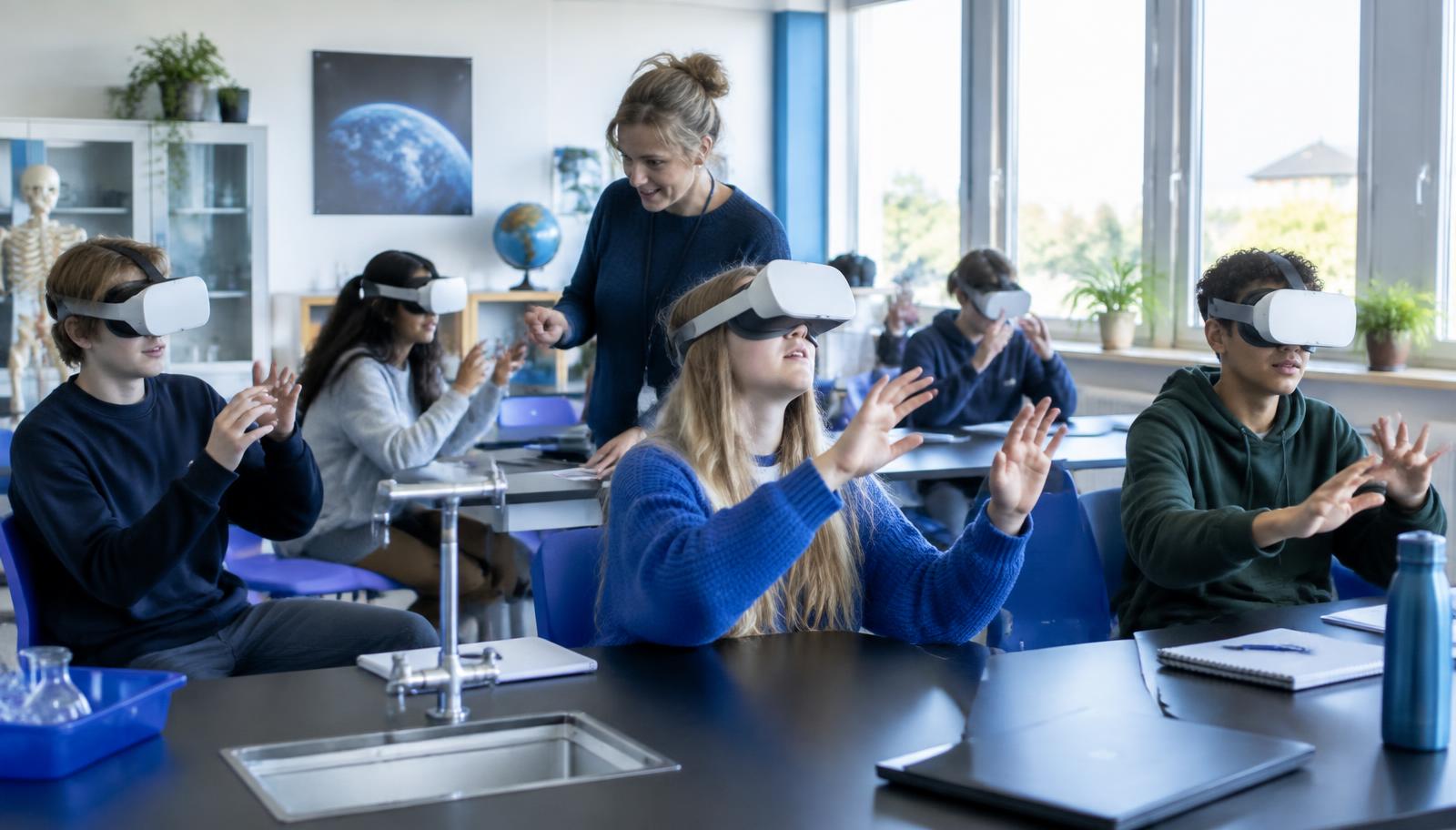
Immersive Learning Solutions for Danish Schools: Start with the Lesson, Not the Headset
The useful question is not ‘Should we buy VR?’
The useful question is: which learning objective is difficult to achieve with the resources available today? A headset is not an education strategy. It becomes useful when it lets students observe a system that is inaccessible, rehearse a procedure safely, manipulate a three-dimensional model, or experience a place that the class cannot visit.
For a Danish school, that may mean exploring anatomy without a laboratory specimen, walking through a historical environment before source analysis, or visualising forces and scale in science. The teacher still frames the task, asks the questions and leads reflection. Immersion supports that teaching; it does not replace it.
Choose one curriculum problem
A strong first use case has a named year group, subject, learning objective and assessment method. ‘Use VR in science’ is too broad. ‘Help Year 8 students explain the relationship between organ structure and function’ is testable.
Begin by mapping the existing lesson. Identify where pupils struggle, what cannot be shown adequately, and what evidence would demonstrate improved understanding. Only then compare an immersive simulation with lower-cost alternatives such as physical models, video or a teacher demonstration.
Design for the teacher-led lesson
Immersive learning works best as a sequence: preparation before the experience, a short focused activity, and discussion or creation afterwards. Not every student needs to wear a headset simultaneously. Rotating stations can combine headsets, tablets, printed prompts and group observation while protecting teaching time.
Teachers need a clear run sheet, learning prompts, troubleshooting guidance and permission to adapt the activity. Professional development should cover pedagogy and classroom orchestration, not only device controls.
Accessibility, wellbeing and privacy belong in the pilot
Schools should provide an equivalent route for learners who cannot or prefer not to use a headset. Session length, movement, seated options, visual comfort, hygiene and supervision should be set before the lesson. Content should be reviewed for age appropriateness and sensory load.
Privacy review should document what learner data is collected, where it is processed, who can access it and how long it is retained. Avoid collecting personal data simply because a platform allows it. A focused pilot can often be designed with minimal or no identifiable learner data.
Measure learning and feasibility separately
A successful demonstration can still be a poor school deployment. Evaluate two things. First, learning: can pupils explain, apply or retain the target concept? Second, feasibility: can teachers prepare and run the activity reliably within the timetable?
Useful evidence includes a short pre/post task, examples of student explanations, teacher observation, participation patterns, accessibility feedback, setup time and technical interruptions. Engagement matters, but ‘students enjoyed it’ is not enough to justify scale.
A sensible first step
XRPK Solutions helps schools and municipalities define one learning problem, select or develop the right experience, prepare teachers and evaluate a contained pilot before purchasing at scale. No Danish institution or result is implied here; this is the delivery model we propose.
Review our immersive education approach, then email us to discuss a Danish school pilot with a clear objective, safeguards and decision criteria.
Plan an Education Pilot
Discuss one learning objective, the constraints and the evidence your institution needs before deciding whether to scale.
XRPK Solutions
European Industry 4.0 solutions — IIoT, AI predictive maintenance & VR training. Kastrup, Denmark & Lahore.